Blood Alcohol Level (BAC) Chart
A comprehensive visual guide to understanding how different Blood Alcohol Concentration (BAC) levels affect your body, behavior, and driving ability. Use this reference to understand impairment levels and legal limits.
Blood Alcohol Concentration (BAC) Chart
Blood Alcohol Concentration (BAC) is measured as a percentage of alcohol in your bloodstream. This chart visualizes how different BAC levels correspond to various physical and mental effects, from mild relaxation to life-threatening impairment.
Visual representation of Blood Alcohol Concentration (BAC) levels and their corresponding effects on the human body
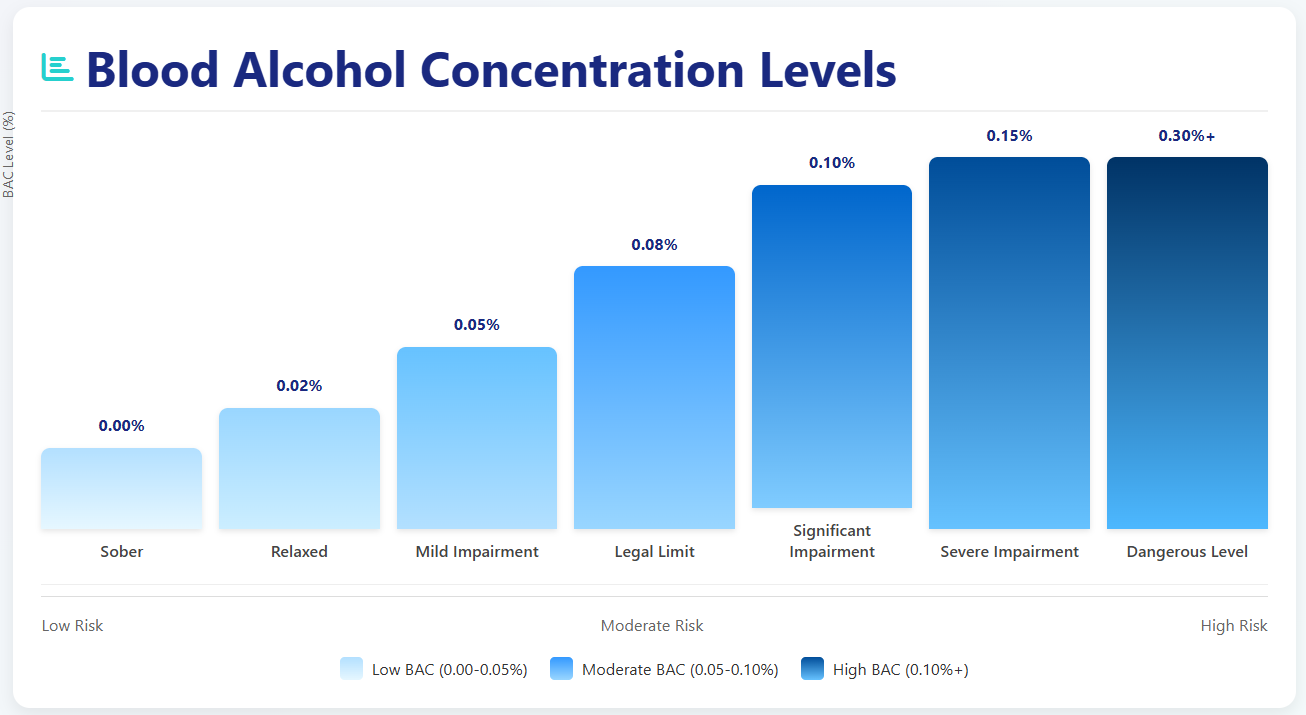
Detailed BAC effects chart showing impairment levels at different blood alcohol concentrations
BAC Effects on Body and Behavior
The table below details how different BAC levels affect cognitive function, physical coordination, and emotional state. Individual responses may vary based on tolerance, body composition, and other factors.
| BAC Level | Typical Effects | Physical Symptoms | Driving Impairment | Legal Status |
|---|---|---|---|---|
| 0.01% - 0.03% | Mild relaxation, slight euphoria, lowered inhibitions | No loss of coordination, slight warmth | Minimal to no impairment | Legal to drive (but not recommended) |
| 0.04% - 0.06% | Feeling of well-being, relaxation, lower inhibitions, minor impairment of judgment | Warmth, flushing, minor motor skill impairment | Judgment and alertness affected | Legal in most areas, but impairment begins |
| 0.07% - 0.09% | Euphoria, emotional swings, impaired judgment, lowered inhibitions | Balance, speech, vision, reaction time impaired | Significant impairment, illegal in all US states | DUI illegal limit (0.08% in USA) |
| 0.10% - 0.12% | Over-expression, emotional instability, poor judgment | Poor coordination, slurred speech, slower reaction time | Dangerous impairment, gross motor skills affected | Illegal everywhere, significant impairment |
| 0.13% - 0.15% | Gross motor impairment, anxiety, restlessness | Major loss of balance, blurred vision, dysphoria | Extreme danger, cannot drive safely | Illegal, high risk of accident |
| 0.16% - 0.20% | Nausea, disorientation, possible blackouts | Significant physical impairment, pain dulled | Complete loss of driving ability | Illegal, very high impairment |
| 0.21% - 0.30% | Stupor, loss of understanding, unconsciousness possible | Severe physical impairment, risk of alcohol poisoning | Completely incapacitated | Medical emergency likely |
| 0.31%+ | Coma, unconsciousness, death possible | Life-threatening alcohol poisoning, potential death | No capacity for any activity | Life-threatening medical emergency |
Important Safety Note
BAC affects individuals differently based on tolerance, body weight, metabolism, food consumption, and other factors. These effects are general guidelines. The only safe BAC level for driving is 0.00%. Even small amounts of alcohol can impair judgment and reaction time. Always arrange for a designated driver or alternative transportation if you plan to drink.
BAC Comparison by Gender
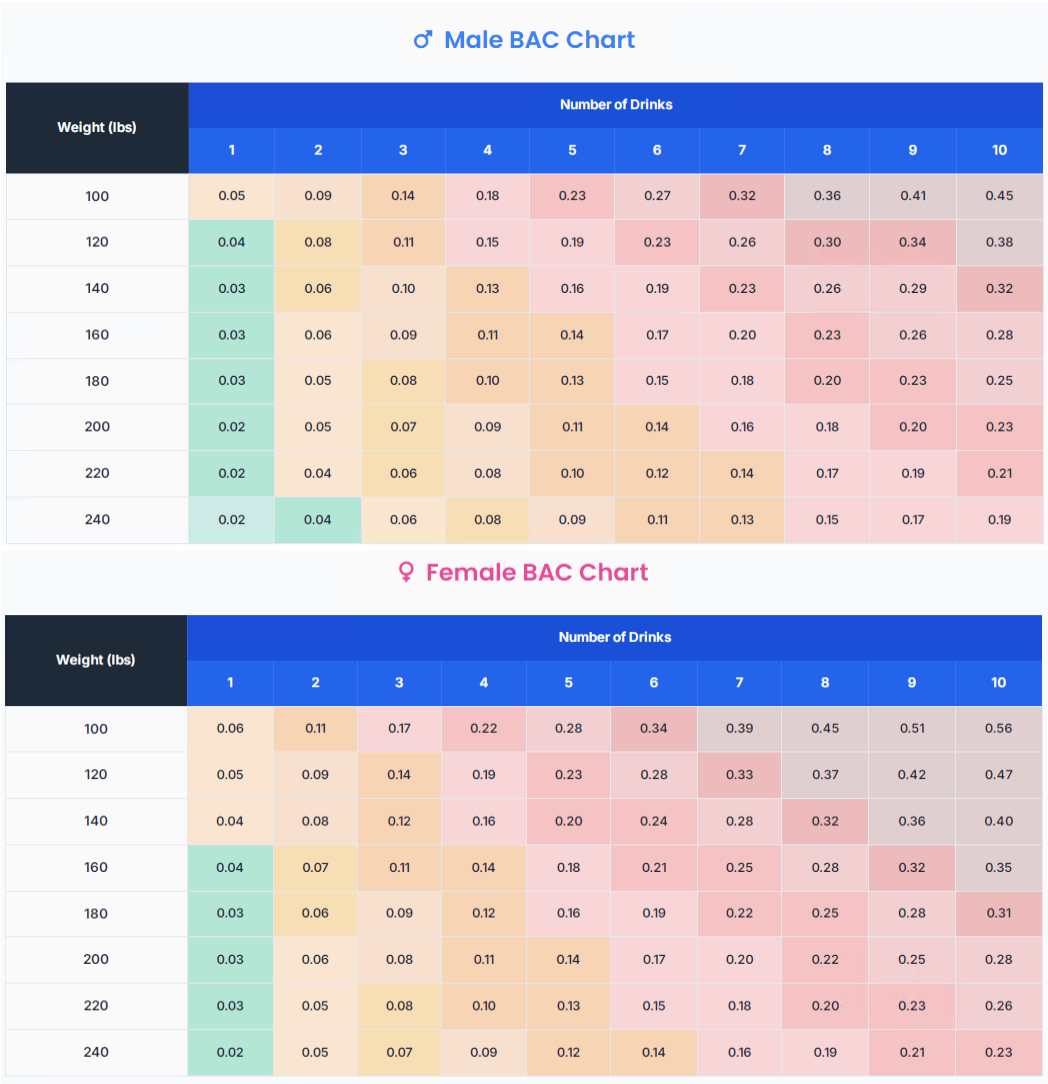
These charts show estimated Blood Alcohol Concentration (BAC) levels for men and women based on body weight and number of drinks consumed. Women generally have a higher percentage of body fat and lower percentage of body water than men of the same weight, which typically results in higher BAC levels after consuming the same amount of alcohol.
Male BAC Chart
| Weight (lbs) | Number of Drinks | |||||||||
|---|---|---|---|---|---|---|---|---|---|---|
| 1 | 2 | 3 | 4 | 5 | 6 | 7 | 8 | 9 | 10 | |
Female BAC Chart
| Weight (lbs) | Number of Drinks | |||||||||
|---|---|---|---|---|---|---|---|---|---|---|
| 1 | 2 | 3 | 4 | 5 | 6 | 7 | 8 | 9 | 10 | |
How to Use These Charts
These charts provide estimated BAC levels based on the Widmark formula. Each "drink" represents:
- 1 oz of 100-proof liquor (50% alcohol)
- 12 oz of regular beer (5% alcohol)
- 5 oz of table wine (12% alcohol)
Important: These are estimates only. Actual BAC can vary by 20% or more due to individual metabolism, food intake, medication, and other factors.
Key Differences Between Men and Women
Women typically reach higher BAC levels than men after consuming the same amount of alcohol because:
- Body Composition: Women generally have higher body fat percentage and lower body water percentage than men.
- Enzyme Levels: Women typically have lower levels of alcohol dehydrogenase, an enzyme that breaks down alcohol in the stomach.
- Hormonal Factors: Hormonal fluctuations can affect alcohol metabolism in women.
Regardless of gender, the only safe BAC for driving is 0.00%. Never drive after drinking.
BAC Legal Limits Comparison
Different countries and driver types have varying legal BAC limits. This comparison shows how BAC limits differ around the world and for different types of drivers.
USA Standard Limit
Legal limit for regular drivers in all 50 states
USA Commercial Drivers
Lower limit for commercial vehicle operators
USA Under 21
Zero tolerance or very low limits for underage drivers
Most European Countries
Standard limit in most EU countries
UK (except Scotland)
England, Wales & Northern Ireland limit
Scotland
Lower limit adopted in 2014
Japan
One of the strictest limits worldwide
Zero Tolerance Countries
Czech Republic, Slovakia, Hungary, Saudi Arabia
Legal Blood Alcohol Concentration (BAC) Limits
Blood Alcohol Concentration (BAC) limits vary significantly across different jurisdictions. The following tables detail the legal limits for driving under the influence (DUI) or driving while intoxicated (DWI) in the United States by state, and in countries around the world. These are legal thresholds; impairment can occur at lower levels.
United States: BAC Limits by State
In the United States, the legal limit for most drivers aged 21 and over is 0.08% . However, individual states have the authority to set stricter limits or rules for specific groups like commercial drivers, novice drivers, and those under 21.
| State / Jurisdiction | Standard BAC Limit (General Drivers) | Special Limits & Notable Laws | Key Penalties & Notes |
|---|---|---|---|
| Utah | 0.05% | First state to lower limit to 0.05% (2018). Judges can ban alcohol purchases for extreme DUI (0.16%+). | Considered the strictest state for DUI laws. |
| All Other States (e.g., RI, AZ) | 0.08% | Under 21: 0.00% - 0.02% “Zero Tolerance”. Commercial Drivers: 0.04%. | In Arizona, drivers can be charged if “impaired to the slightest degree” even under 0.08%. In RI, 0.02%-0.08% for under 21 is “Driving While Impaired” (DWI). |
| Washington (Proposed) | 0.08% (Current) | Bill passed Senate to lower limit to 0.05%, effective July 2026 if enacted. | Bill SB 5067 aims to reduce traffic fatalities; opposition cites potential impact on moderate drinkers. |
International BAC Limits
Globally, BAC limits range from zero-tolerance to 0.08%, with many countries implementing lower limits for novice, young, or professional drivers. Enforcement and penalties vary widely.
| Country / Region | Standard BAC Limit | Special Limits & Groups | Key Penalties & Context |
|---|---|---|---|
| Czechia (Czech Republic) | 0.00% (Zero Tolerance) | Applies to all drivers. Technical tolerance up to 0.024% may be allowed. | Random breath testing is mandatory. Refusal leads to heavy fines and a driving ban. Policy in place since 1953. |
| Sweden, Norway | 0.02% (De facto zero-tolerance) | Sweden: 0.02% for all drivers. Norway: 0.02%. | Penalties are severe, including income-based fines and imprisonment. Sweden has some of Europe's lowest drink-driving deaths. |
| Poland | 0.02% (Criminal offense above 0.05%) | Two-tier system: 0.02‰-0.05‰ is a misdemeanor; above 0.05‰ is a criminal offense. | High BAC, repeat offenses, or causing an accident lead to aggravated charges, long driving bans, and vehicle forfeiture. |
| United Kingdom | 0.08% (England, Wales, NI) | Scotland: 0.05%. Proposed to lower all UK to 0.05%. Novice/Bus drivers: Lower limits. | The UK government is consulting on lowering the limit for the first time since 1967 as part of a new road safety strategy. |
| Germany, France, Spain, Australia | 0.05% | Germany/France/Spain/Australia: Zero tolerance for novice, young (e.g., under 21), and professional drivers. Spain: Universal limit may drop to 0.02% in late 2025. | Penalties escalate with BAC level and repeat offenses. France treats some alcohol-related road deaths as “road homicide”. |
| Japan | 0.03% | Extremely strict enforcement. Passengers and those who serve alcohol to a driver can also be penalized. | Penalties include heavy fines (up to ~1 million yen) and imprisonment (up to 5 years). |
| South Africa | 0.05% (General), 0.02% (Professional) | Government announced plans in Jan 2026 to amend law to a zero-tolerance policy, scrapping the current legal limits. | Current law dates back ~30 years. The proposed change aims for a clear “no drinking and driving” policy. |
| United Arab Emirates (UAE) | 0.00% (Zero Tolerance) | Applies to all drivers. | Penalties are severe and can include jail time, hefty fines, and deportation for non-citizens. |
| Countries with No Set BAC Limit (e.g., Kenya, Gambia, Barbados) | Not Specified | No prescribed BAC limit. | Drivers can still be prosecuted under general “dangerous driving” laws, but enforcement is often inconsistent. |
Important Legal Disclaimer
This information is for general reference and educational purposes only. Laws and penalties are subject to change and can vary by local jurisdiction. The enforcement and application of these laws depend on specific circumstances. This is not legal advice. For definitive legal guidance or if facing charges, you must consult with a qualified legal professional in the relevant jurisdiction.
Standard Drinks Reference
A "standard drink" contains approximately 14 grams (0.6 ounces) of pure alcohol. Different alcoholic beverages contain varying amounts of alcohol. Understanding standard drink equivalents helps you better estimate your BAC.
Regular Beer
12 oz (355 ml)
5% alcohol by volume
Raises BAC by ~0.02% for 160lb person
Table Wine
5 oz (148 ml)
12% alcohol by volume
Raises BAC by ~0.02% for 160lb person
Distilled Spirits
1.5 oz (44 ml)
40% alcohol by volume
Raises BAC by ~0.02% for 160lb person
Craft Beer (Strong)
8-9 oz (237-266 ml)
7-9% alcohol by volume
Equivalent to 1.5 regular beers
Important Considerations
Actual alcohol content can vary significantly between brands and serving sizes. Craft beers often have higher ABV than regular beers. Mixed drinks can contain multiple shots of liquor, making them equivalent to several standard drinks. Always check labels for accurate alcohol percentage information and remember that BAC calculators provide estimates only.
Alcohol Metabolism & Elimination
Understanding how your body processes alcohol is crucial for interpreting BAC levels and estimating when you'll be sober. The liver metabolizes alcohol at a relatively constant rate that cannot be accelerated.
Safe Driving Reminder
Regardless of legal limits, the only safe BAC for driving is 0.00%. Even small amounts of alcohol can impair judgment, reaction time, and driving ability. When in doubt, don't drive. Always arrange for a designated driver or alternative transportation. Remember that many DUI arrests occur the morning after drinking when BAC may still be above legal limits.
Frequently Asked Questions (FAQ) About BAC
Find quick answers to the most common questions about Blood Alcohol Concentration (BAC), its effects, legal implications, and safety.
Blood Alcohol Concentration (BAC) is a precise measurement of the amount of alcohol present in a person's bloodstream. It is expressed as a percentage by weight per unit volume. For example, a BAC of 0.08% means there are 0.08 grams of alcohol for every 100 milliliters of blood. It is the primary scientific and legal standard used worldwide to define alcohol impairment for activities like driving.
“Natural blood alcohol level” typically refers to the blood alcohol concentration (BAC) in healthy individuals who have not consumed any alcoholic beverages or foods. This level is generally below 0.01 mg/dL (milligrams per deciliter), equivalent to 0.00001%. This naturally occurring blood alcohol content is extremely low, far below the detection threshold of standard breathalyzers (typically 0.02% BAC), and is considered “zero” in forensic or traffic testing.
The minute trace amounts of endogenous alcohol present in blood are primarily produced by fermentation from gut microbiota, human metabolism, or, in rare cases, abnormal fermentation within the intestines caused by certain diseases, leading to significant accumulation of alcohol within the body.
In the United States, the legal maximum blood alcohol concentration (BAC) for drivers aged 21 and older is 0.08%. However, lower BAC limits apply in certain jurisdictions and for specific groups, such as: 0.05% in Utah, 0.04% for commercial drivers, and 0.01% to 0.02% for drivers under 21. Drivers may still be charged with driving under the influence even if their blood alcohol concentration is below these limits.
If you are a man weighing between 100-240 lbs, drinking one 12-ounce bottle of beer (5% ABV) will raise your blood alcohol concentration (BAC) to 0.019%-0.045%. It takes approximately 1.3-3 hours for your body to fully metabolize the alcohol from one bottle of beer.
If you are a woman weighing 100-240 lbs, drinking one 12-ounce bottle of beer (5% ABV) will raise your blood alcohol concentration to 0.023%-0.056%. It will take 1.6-3.7 hours for your body to fully metabolize the alcohol from one bottle of beer.
Drinking one glass of wine (12% alcohol, 5 oz) is equivalent to drinking one 12-ounce glass of beer with 5% alcohol. Refer to the answer above for details.
Drinking one shot of hard liquor (40% alcohol, 1.5 oz) is equivalent to drinking one 12-ounce beer with 5% alcohol content. Both share the same metabolism time and blood alcohol concentration. You can directly refer to the answer for one beer.
Blood alcohol concentration (BAC) can be determined through breath, blood, urine, and saliva testing. Breathalyzers are the most commonly used method but not the most accurate. The most precise method involves drawing venous blood and analyzing its ethanol content. Other methods such as PEth testing (blood), saliva testing, and hair testing are less frequently used. While still prone to error, a self-testing method available when these instruments or conditions are unavailable is estimating alcohol concentration using a BAC calculator.
- Breathalyzer (Breath Test): Typically, drivers suspected of drunk driving are asked to exhale into a breathalyzer, which measures alcohol content in exhaled breath. This provides rapid results with relatively high accuracy.
- Blood Testing: Analyzed using gas chromatography, enzymatic methods, or the dichromate method. It can measure blood alcohol concentration up to 12 hours after drinking.
- Urine Testing (EtG/EtS): Detects alcohol consumption within the past 12-24 hours. For heavy drinkers, it can detect consumption up to 72 hours prior.
- Saliva testing: Measures alcohol concentration in saliva, which correlates closely with blood alcohol levels.
- Phosphatidylethanol (PEth) testing: This method can detect alcohol consumption from several weeks prior.
When we see police conducting DUI checks on TV, they typically use a breathalyzer device that drivers blow into to detect alcohol impairment. This breathalyzer is essentially a compact, handheld Preliminary Alcohol Screening (PAS) device, such as the Alco Sensor IV, which provides a rapid estimate of blood alcohol content. If the reading exceeds the legal limit, the driver is taken to the police station for an official confirmation test using a larger, more precise Evidential Breath Testing (EBT) device, like the Intoxilyzer 8000. This equipment provides printed results that serve as formal evidence in court, meeting stricter legal standards.
- Gray-cap tubes (preferred): Contain sodium fluoride (preservative) and potassium oxalate (anticoagulant) to prevent blood cell breakdown and alcohol consumption.
- Red-cap tubes (standard or gel-type): Used for serum separation, typically as an alternative when gray caps are unavailable, but require immediate separation from cells for medical testing.
- Lavender/Pink Cap Tubes (EDTA): Contain the anticoagulant EDTA and are accepted by certain laboratories, particularly routine chemistry/hematology labs.
- Green Cap Tubes (Heparin): Used for plasma testing and occasionally for medical alcohol testing (STAT).
The average rate of decrease in blood alcohol concentration (BAC) is 0.015% per hour. The human body's rate of alcohol metabolism is relatively stable and is generally unaffected by other factors such as cold showers, coffee, exercise, or fresh air, which do not accelerate the metabolic process.
The human body typically requires approximately 1.3 to 3.7 hours to metabolize one standard drink (12 ounces of beer, 5 ounces of wine, or 1.5 ounces of spirits). If blood alcohol concentration reaches 0.08% after drinking, it takes over 5 hours to reduce it back to 0.00%.
The blood alcohol concentration (BAC) in a healthy human body is extremely low, almost negligible. However, when you consume alcohol or alcohol-containing foods too quickly—exceeding the liver's ability to metabolize it—the BAC gradually rises. Several factors influence blood alcohol concentration:
- Rate of consumption: Rapid drinking, gulping, binge drinking, or consuming large quantities of alcoholic foods can overload the liver, leading to rapid alcohol accumulation.
- Consumption rate: The more alcohol you drink and the faster you consume it, the higher your BAC will be, as the liver can metabolize approximately one alcoholic drink per hour.
- Empty stomach: Food slows alcohol absorption; on an empty stomach, alcohol enters the bloodstream more rapidly.
Since the liver's rate of alcohol metabolism is relatively stable, it is recommended to slow down alcohol intake by eating before and after drinking. Additionally, alternating alcoholic beverages with water during drinking helps maintain adequate hydration and prevents rapid increases in blood alcohol concentration. Remember to control your drinking pace—avoid drinking too quickly, otherwise BAC will still rise rapidly.
After drinking, your blood alcohol concentration (BAC) begins to impair your judgment when it reaches 0.02%. As you consume more alcohol, this concentration rises. At around 0.05%, more pronounced impairment and reduced inhibitions typically occur. In many countries and regions, 0.08% is the legal threshold for impaired driving (DUI/DWI). Reaching 0.10%–0.12% leads to noticeable lack of coordination, impaired judgment and memory, and difficulty with motor skills.
When your BAC reaches 0.15 to 0.30 g%, your life is at high risk. Potential symptoms include difficulty breathing, inability to walk independently, loss of bladder control, and even unconsciousness.
Some friends who enjoy drinking may also frequently ask, “What blood alcohol level causes death?” or “What blood alcohol level leads to blackout?” A lethal blood alcohol level is a BAC exceeding 0.30 g%, which makes it extremely likely for a person to lose consciousness, fall into a coma, or even die.
When blood alcohol concentration (BAC) reaches 0.30% to 0.40%, the body is highly likely to be in a state of alcohol intoxication. This condition is extremely dangerous, often leading to loss of consciousness and posing a life-threatening risk. When BAC exceeds 0.40%, the mortality rate becomes extremely high.
The highest recorded blood alcohol concentration (BAC) among documented survivors was 1.374% (13.74 g/L). This was a 40-year-old Polish man discovered in July 2013 in a state of alcohol poisoning, unconscious. Fortunately, he ultimately survived.
An even higher record exists: a 28-year-old Polish man discovered with a BAC of 1.480% (14.8 g/L). However, he died from injuries sustained in a car accident, not alcohol poisoning. This further underscores that countless accidents occur annually due to drunk driving. For your safety and the safety of others, never drink and drive. Stay safe.
Important Medical & Legal Disclaimer
This blood alcohol level chart is for educational and informational purposes only. It should not be used to determine if you are safe to drive or make decisions about alcohol consumption. Individual responses to alcohol vary significantly. The only safe BAC for driving is 0.00%. This information is not medical advice. If you or someone you know is experiencing alcohol poisoning symptoms (confusion, vomiting, seizures, slow breathing, unconsciousness), seek emergency medical attention immediately. Always drink responsibly and never drink and drive.